- Enquiry For Sales in IND : +91 99505 08668
Enquiry For Sales in USA : +1 (716) 599-8595 - Request for quote

LLM
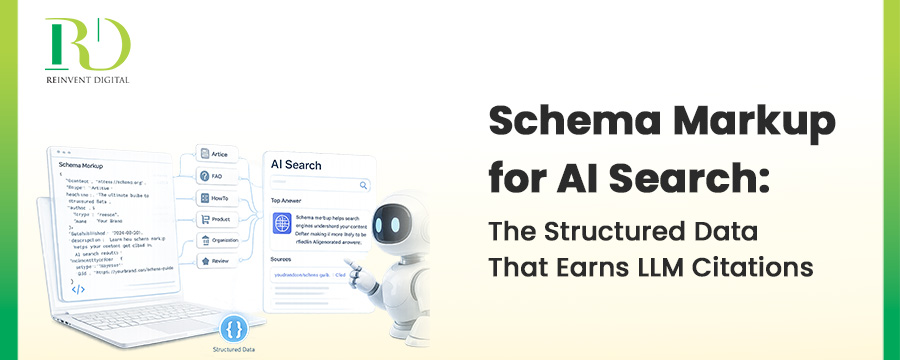
Your content is published. It is accurate. It answers the right questions. But when someone asks ChatGPT or Gemini, a competitor gets cited and not you. Large Language Models do not read pages the way humans do. They process structure, resolve entity relationships and make probabilistic decisions about what a page represents.
When that structure is missing, AI systems either misread the content or skip it entirely. Schema markup is the layer that removes that guesswork, telling AI systems exactly what your page is, who wrote it and what it answers.
Reinvent Digital has built Generative Engine Optimisation (GEO) and Answer Engine Optimisation (AEO) strategies for 155+ clients across healthcare, e-commerce and B2B structuring content so LLMs can extract, trust and cite it. With 245+ projects, schema implementation is one of the first technical layers we put in place.
Schema markup for AI search matters for LLM citations because it replaces machine guesswork with machine-readable facts. When an AI retrieves your page, structured data tells it directly what your content is, removing the ambiguity that causes pages to get skipped or misattributed in AI-generated answers.
According to an SEranking dataset, 71% of pages cited by ChatGPT include structured data. But schema alone does not guarantee citations. What the schema does is remove the barrier. Content still needs to be accurate, well-structured and genuinely useful.

The schema types that consistently earn LLM citations are FAQPage, Article, Organisation, How To page. Each one serves a different purpose. Choosing the right type for each page is what makes implementation work.
FAQ Page schema structures your question-and-answer content in a format LLMs actively prefer when generating responses. A FAQ Page block is organised as a list of question-answer pairs, which is exactly the format an AI reaches for when it wants a clear, attributable answer to include in its output.
For healthcare brands, hospitals, dental clinics, IVF centres, FAQPage schema on patient question pages is the single highest-impact schema implementation. “What is the recovery time after a root canal?” answered in a FAQ page block is AI-extractable within seconds of crawling.
The article schema tells AI systems who wrote the content, when it was published and when it was last updated. These three signals : author, date published and date modified, directly support E-E-A-T verification.
LLMs do not just evaluate what a page says. They evaluate whether the source is credible enough to cite. For doctor-authored treatment guides, specialist explainers and healthcare blogs, Article schema by top digital marketing agency for healthcare, with full author markup is non-negotiable. I
Organisation schema defines your brand as a clearly identifiable entity, name, URL, logo, contact details and links connecting your profiles across LinkedIn, Google Business Profile and other platforms.
LLMs cross-reference brand information across multiple sources. If your brand name appears differently across your website, directories and social profiles, AI systems cannot confidently connect them as one entity. Organisation schema standardises that information in one machine-readable block, reducing ambiguity and improving the confidence with which AI systems reference your brand.
How To schema structures step-by-step content in a format AI systems extract directly when generating process-based answers. Each step is labelled, sequenced and machine-readable, which is exactly what an LLM needs when a user asks “how do I” or “what are the steps to.”
For Reinvent Digital clients, HowTo schema works particularly well on:
Healthcare content faces the strictest AI scrutiny. Google’s Your Money or Your Life (YMYL) guidelines and AI systems’ own credibility checks both apply heightened standards to medical information.
MedicalWebPage schema identifies a page as medical content and signals the medical audience it is written for. Physician schema on doctor profile pages defines the doctor’s name, credentials, specialty and affiliated institution in machine-readable format, creating a verifiable authority signal that AI systems can check against third-party sources.
For a digital marketing agency in Hyderabad, hospitals, eye clinics, IVF centres and dental chains, implementing these two schema types on every treatment page and doctor profile is the baseline requirement for AI search visibility.
Schema that does not match visible page content is worse than no schema. Google’s John Mueller confirmed in 2025 that structured data is not a direct ranking factor, but misleading or mismatched schema actively harms credibility with both search engines and AI systems.
Three rules that make schema work:
Match schema to visible content exactly. If your FAQPage schema lists five questions, all five must be visible on the page. If your Article schema names an author, that author’s name and bio must appear on the page.
Always use JSON-LD. JSON-LD is implemented by a digital marketing company in India, as a script block in the page head, separate from the visible HTML. It is the format Google recommends, the format Microsoft’s LLMs process most reliably and the format that maps most directly to the Q&A and entity structures AI systems prefer.
Update dateModified every time content changes. AI crawlers use this timestamp to assess whether content is current. A page updated in 2025 with a 2022 dateModified timestamp sends the wrong freshness signal.
Most brands either have no schema, outdated schema or schema that does not match their visible content. All three are barriers to LLM citation. Here is how Reinvent Digital fixes that:
Speak to Reinvent Digital, an AEO agency in India about AI search visibility for your brand. Call: +91 99505 08668.
What is schema markup in simple terms?
It is code added to a webpage that tells AI systems and search engines exactly what the page is about, who wrote it and what questions it answers.
Does schema markup guarantee AI citations?
No. Schema removes the barrier to citation, it does not guarantee one. Content still needs to be accurate, well-structured and genuinely useful for AI systems to cite it.
Which schema type matters most for AI search?
FAQPage schema consistently drives the most direct citation improvements because it pre-packages content in the Q&A format LLMs prefer when generating answers.
How do I know if my schema is working?
Test every schema block in Google’s Rich Results Test. Monitor AI citation frequency using tools like Otterly.AI. Track whether schema-enhanced pages appear as cited sources more often after implementation.